For millions of Filipinos, riding a motorcycle is not a hobby. It is how they get to work, deliver food, earn a living, bring their families around, or simply move through a country where traffic can turn a short trip into a long one. Motorcycles have become an important part of Philippine mobility, and their growing use has also created new challenges for riders, motorists, government and communities. The Asian Development Bank has described motorcycles as an increasingly important mode of daily transport and logistics in Metro Manila. (Asian Development Bank)
But ask riders what makes riding difficult in the Philippines, and the answer is rarely just one thing.
Sometimes, it is the road itself.
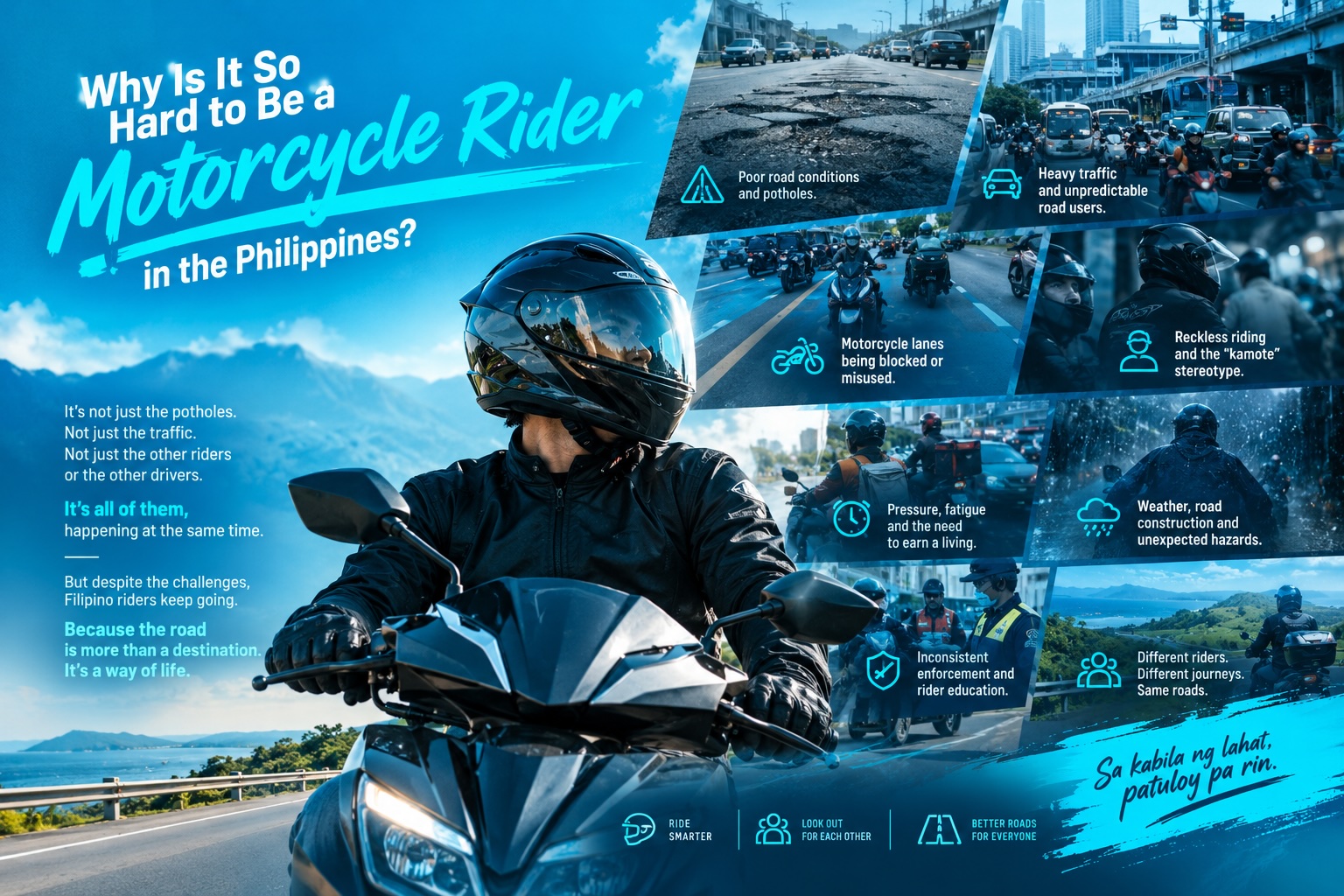
Potholes, uneven pavement, poorly maintained surfaces, road construction and sudden changes in road conditions can be particularly dangerous on two wheels. A car can often roll over a road defect with little consequence. For a motorcycle, the same pothole can upset the bike, especially when encountered at speed or in the rain. A recent study involving motorcycle riders in the Philippines identified poor road maintenance, potholes, heavy traffic and inadequate motorcycle facilities among the concerns riders experience. (NCTS)
Then there is traffic.
Motorcycles are small enough to move through congested roads, which is one reason they are so useful. But that same advantage can become a source of conflict. Riders filter through traffic while cars change lanes, buses stop suddenly, tricycles move unpredictably and pedestrians cross wherever they can. Everyone is trying to find a little space on roads that often feel like they have none left.
Motorcycle lanes are supposed to help, but even those can become complicated. Research from the University of the Philippines has pointed to problems involving congestion, vehicles occupying motorcycle lanes and other vehicles using roads or lanes that were not designed for them. (NCTS)
And then there are the riders themselves.
No honest discussion about Philippine motorcycle culture can ignore reckless riding. Counterflowing, running red lights, speeding, cutting between vehicles, ignoring lane markings and riding without proper safety equipment are not imaginary problems. They are real behaviors that put riders and everyone around them at risk. The MMDA has continued to emphasize rider education and safer riding practices, including its Motorcycle Riding Academy. (Philippine Information Agency)
But calling every rider a “kamote” does not explain the whole problem.
Some riders are reckless because they are careless. Some are inexperienced. Others are under pressure. For delivery riders and motorcycle taxi drivers, time is money. A delayed delivery can mean less income. A long queue or traffic jam can mean falling behind a daily target. Heat, fatigue, hunger and pressure can gradually affect judgment. Recent local commentary and rider discussions have pointed to these economic and environmental pressures as part of the behavior seen on the road. (VISOR)
That does not excuse dangerous riding. But understanding why something happens is different from defending it.
There is another side to the story that riders often talk about: being seen.
A motorcycle occupies much less physical space than a car or truck. That can make it easier for other motorists to overlook. A car changing lanes may not notice a motorcycle beside it. A vehicle turning across an intersection may misjudge the rider's position or speed. For the rider, a few seconds of another driver's mistake can become a serious problem.
This creates an uncomfortable reality: motorcycle safety is not only the responsibility of motorcycle riders.
Riders have to follow traffic rules, maintain their motorcycles, wear proper protective equipment and develop better riding skills. But other road users also have a responsibility to look carefully, signal properly, maintain safe distances and understand that motorcycles are legitimate road users too.
The road has to be shared.
Unfortunately, the relationship between riders and other motorists is not always friendly. There is frustration on both sides. Drivers complain that motorcycles suddenly appear between lanes. Riders complain that cars squeeze them out, fail to check blind spots or treat them as if they have no right to be on the road. Online rider communities regularly reflect this tension, with complaints about both reckless riders and the behavior of other motorists. (Reddit)
Enforcement is another part of the problem.
Riders want dangerous behavior punished. But they also want rules applied fairly and consistently. A UP transportation study identified ineffective enforcement, perceived discrimination at checkpoints and concerns about interactions with enforcement personnel among issues reported by motorcycle riders. (NCTS)
This is where the conversation becomes bigger than motorcycles.
The Philippines has roads designed around many different types of vehicles, but motorcycles have often been treated as an afterthought. Research has noted that many roads were originally designed around four-wheeled vehicles, despite the growing importance of motorcycles in Philippine transportation. (Socioeconomic Research Portal)
And motorcycles are no longer a small part of the transportation picture.
They are commuters. They are delivery riders. They are motorcycle taxis. They are parents going to work. They are small-business owners. They are weekend riders heading to the mountains, the coast or the nearest café. They are also enthusiasts who ride simply because they love being on two wheels.
That diversity is important.
The everyday commuter has different problems from the weekend rider. A delivery rider has different pressures from someone taking a Sunday morning ride. A beginner has different needs from someone who has been riding for twenty years.
But they all share the same roads.
And perhaps that is the real reason it is so hard to be a motorcycle rider in the Philippines.
It is not just the potholes. It is not just the traffic. It is not just reckless riders, careless motorists, confusing road design, inconsistent enforcement or the lack of rider education.
It is all of them happening at the same time.
The answer cannot simply be to blame riders. Nor can it be to blame cars, government or the roads.
Better riding matters. Better road design matters. Better enforcement matters. Better education matters. And perhaps most importantly, better understanding between road users matters.
Because at the end of the day, most riders are not trying to win a race against everyone else on the road.
They are simply trying to get where they are going.
Safely.
And maybe that is the conversation Philippine motorcycle culture needs more of—not “riders versus drivers,” but “how do we make the road work better for everyone?”
For the rider, the goal should be simple:
Ride smarter. Ride responsibly. Look out for each other. And make it home.